Unpaid loans, outstanding business dues and defaulted financial obligations can create serious difficulties for individuals, lenders and business owners. When a borrower or debtor fails to repay an amount despite repeated requests, the creditor may need to consider appropriate legal remedies to recover the outstanding debt.
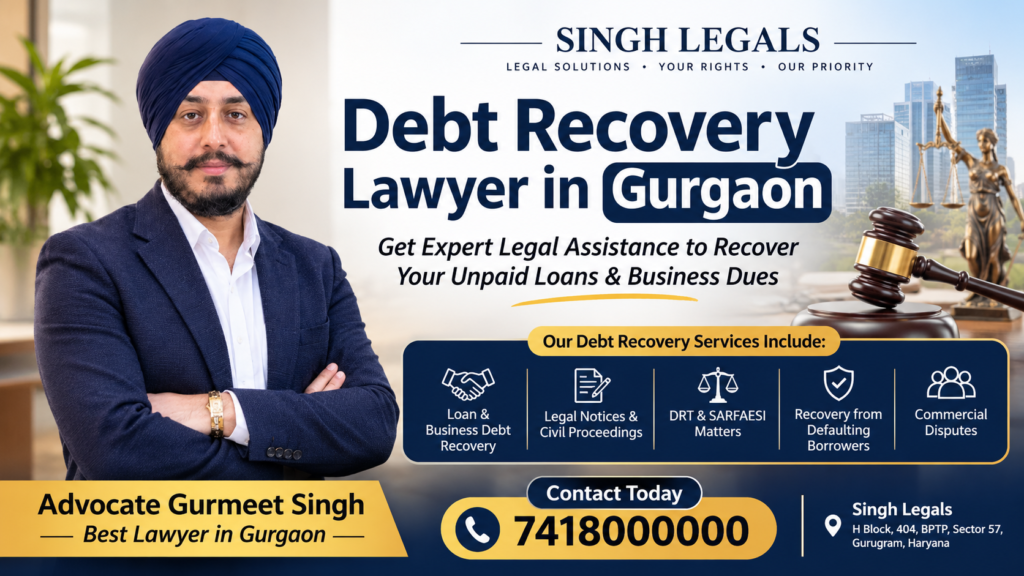
If you are looking for a debt recovery lawyer in Gurgaon, Singh Legals provides legal assistance in debt-related disputes, including review of loan documents, recovery notices, contractual claims and appropriate legal proceedings.
Led by Advocate Gurmeet Singh, who has over 22 years of legal experience, Singh Legals assists individuals and businesses with legal matters in Gurgaon and other locations.
Debt Recovery Legal Services in Gurgaon
Debt recovery involves legal steps taken by a creditor to recover money owed by a borrower, customer, business partner or another person. The appropriate remedy depends on the nature of the debt, available documents, amount involved, security provided and applicable law.
1. Recovery of Outstanding Loans
When a borrower fails to repay a personal or business loan, the lender may need legal assistance to understand the available recovery options.
Legal assistance may include:
- Reviewing loan agreements and repayment terms.
- Examining payment records and outstanding balances.
- Reviewing communications between the parties.
- Preparing a legal demand notice where appropriate.
- Assessing the possibility of initiating recovery proceedings.
- Advising on legally available remedies.
The legal approach depends on the terms of the loan and the evidence supporting the claim.
2. Business Debt Recovery
Businesses may face financial difficulties when customers, vendors, distributors or business partners fail to clear outstanding payments.
Debt recovery assistance may relate to:
- Unpaid business invoices.
- Outstanding payments under commercial agreements.
- Unpaid supply and service charges.
- Business loans and advances.
- Contractual payment defaults.
- Outstanding dues between companies or firms.
The relevant agreements, invoices, delivery records and payment correspondence can help establish the nature of the outstanding claim.
3. Recovery of Money From Defaulting Borrowers
When a borrower repeatedly fails to fulfil repayment obligations, a creditor may consider formal legal action.
A lawyer can examine the loan transaction, repayment schedule, acknowledgements, security documents and other available evidence to assess the appropriate course of action.
Depending on the circumstances, this may involve a legal notice, negotiation, a civil recovery suit or another statutory procedure.
4. Legal Notices for Debt Recovery
A legal notice can formally communicate the creditor’s demand and provide an opportunity for the debtor to respond or make payment.
Legal assistance may include:
- Drafting a debt recovery demand notice.
- Reviewing the amount claimed and supporting documents.
- Setting out the relevant contractual obligations.
- Identifying the basis of the claim.
- Preparing replies to notices received from creditors.
- Advising on the next steps if payment is not made.
A legal notice is not mandatory in every recovery matter. Specific statutory notice requirements may apply depending on the type of proceeding.
5. Recovery of Payments Under Commercial Agreements
Commercial agreements often contain payment terms, credit periods, interest clauses and other obligations.
If one party fails to make payment as agreed, the affected party may have legal remedies depending on the contract and applicable law.
Relevant matters may include unpaid service charges, supply payments, outstanding contractual amounts and other commercial dues.
6. Debt Recovery Through Civil Court Proceedings
Where a debt is legally recoverable through civil proceedings, a creditor may consider filing an appropriate suit before the competent court.
Legal assistance may involve:
- Reviewing documents supporting the debt.
- Assessing limitation and jurisdiction.
- Preparing the plaint and supporting documents.
- Filing the appropriate proceedings.
- Responding to the debtor’s defence.
- Presenting evidence and legal submissions.
- Advising on execution of a decree, where obtained.
The availability of a civil recovery suit depends on the nature of the claim and whether a specialised legal forum has jurisdiction.
7. Recovery of Secured Debts
Some loans are supported by security, such as a mortgage, charge or other legally recognised security interest.
Depending on the creditor’s status, nature of the security and statutory requirements, recovery may involve proceedings under the applicable secured-creditor framework.
For qualifying banks and financial institutions, the SARFAESI Act, 2002 may provide a mechanism for enforcement of security interests. Borrowers and other affected persons may also have remedies under the Act.
The Act does not apply automatically to every private loan or every creditor. Eligibility and statutory requirements must be examined.
8. Debt Recovery Tribunal (DRT) Matters
The Recovery of Debts and Bankruptcy Act, 1993 provides for the establishment of Debts Recovery Tribunals and Appellate Tribunals for matters involving qualifying debts due to banks and financial institutions.
Depending on the nature of the matter, legal assistance may involve:
- Reviewing recovery proceedings.
- Examining notices and applications.
- Understanding the legal position of borrowers and guarantors.
- Preparing appropriate responses.
- Advising on remedies available before the competent tribunal.
- Assisting with related appellate proceedings, where applicable.
DRT jurisdiction is governed by statutory requirements. Not every creditor-debtor dispute can be filed before a DRT.
9. Recovery Against Guarantors
A person who has provided a guarantee for a loan may face legal consequences if the principal borrower defaults.
The rights and obligations of a guarantor depend on the guarantee document and applicable law.
Legal assistance may involve reviewing the guarantee agreement, understanding the extent of liability, examining recovery demands and advising on available legal responses.
10. Debt Recovery From Business Partners and Companies
Financial disputes may arise between business partners, companies, directors, suppliers and service providers.
Such matters may involve:
- Outstanding contractual payments.
- Unpaid invoices.
- Loan and advance disputes.
- Breach of repayment arrangements.
- Disputed business accounts.
- Claims arising from commercial transactions.
The legal route depends on the parties, transaction, amount involved and applicable statutory framework.
When Should You Consult a Debt Recovery Lawyer in Gurgaon?
You may consider obtaining legal advice when:
- A borrower has stopped repaying a loan.
- A customer has failed to clear outstanding invoices.
- A business partner has not returned an advance.
- A company has defaulted on contractual payments.
- A borrower is ignoring repayment reminders.
- You have received a debt recovery notice.
- A bank or financial institution has initiated recovery action.
- You have received a notice relating to a secured loan.
- You are a guarantor facing a repayment demand.
- You need to understand the limitation period for recovering a debt.
Early legal assessment can help identify the appropriate remedy and avoid overlooking important procedural deadlines.
How Does the Debt Recovery Process Work?
The recovery process depends on the nature of the debt and the applicable legal procedure. A typical recovery matter may involve the following stages.
Step 1: Review the Debt and Supporting Documents
The lawyer examines the loan agreement, invoices, repayment records, bank statements, acknowledgements and correspondence to understand the basis of the claim.
Step 2: Calculate the Outstanding Amount
The amount claimed should be assessed with reference to the principal, payments already received, contractual interest and other legally recoverable charges.
Any interest or additional amount claimed must have a valid contractual or legal basis.
Step 3: Examine Limitation and Jurisdiction
The applicable limitation period and the competent court or forum should be identified before initiating proceedings.
The limitation period differs according to the nature of the claim and relevant legal provisions.
Step 4: Send a Legal Notice Where Appropriate
A demand notice may be sent to the debtor setting out the outstanding amount, relevant obligations and requested payment.
The notice should accurately reflect the documents and legal basis of the claim.
Step 5: Consider Negotiation or Settlement
In suitable matters, the parties may explore repayment arrangements, instalments or a negotiated settlement.
Any settlement should be documented carefully and should clearly state the agreed payment terms.
Step 6: Initiate Appropriate Legal Proceedings
If the debt remains unpaid, the creditor may consider an appropriate legal proceeding. Depending on the matter, this could involve a civil recovery suit, commercial dispute proceedings, DRT proceedings or another statutory mechanism.
Step 7: Evidence and Court or Tribunal Proceedings
The parties may be required to present documents, evidence and legal submissions before the competent forum.
Step 8: Enforcement of the Order or Decree
If a legally enforceable decree, order or recovery certificate is obtained, further enforcement proceedings may be required to recover the amount.
The exact procedure and available enforcement methods depend on the applicable law.
Important Laws Relating to Debt Recovery in India
Different laws may apply depending on the creditor, debtor, transaction and type of recovery proceeding.
1. Recovery of Debts and Bankruptcy Act, 1993
This legislation provides for Debts Recovery Tribunals and Debts Recovery Appellate Tribunals to adjudicate qualifying recovery claims involving banks and financial institutions.
2. SARFAESI Act, 2002
The Securitisation and Reconstruction of Financial Assets and Enforcement of Security Interest Act, 2002 provides a framework for eligible secured creditors to enforce security interests, subject to statutory conditions.
3. Code of Civil Procedure, 1908
The CPC governs the procedure for many civil recovery suits, including filing, trial, interim applications and execution of decrees.
4. Limitation Act, 1963
The Limitation Act prescribes time limits for different types of suits and applications. The applicable period depends on the legal nature of the debt and relevant facts.
5. Commercial Courts Act, 2015
Qualifying commercial disputes may be subject to the Commercial Courts Act, 2015, including its provisions on specified value and pre-institution mediation, where applicable.
6. Insolvency and Bankruptcy Code, 2016
The IBC provides a statutory insolvency resolution framework for eligible corporate debtors and other categories covered by the Code. It is not simply a general debt collection mechanism and must not be used as a substitute for ordinary recovery proceedings.
For official statutory references, consult:
Which Forum Handles Debt Recovery Matters in Gurgaon?
The appropriate forum depends on the nature of the debt, parties involved, amount claimed, territorial and pecuniary jurisdiction, and applicable statutory framework.
Depending on the matter, proceedings may be considered before:
- A competent civil court.
- A competent commercial court.
- A Debts Recovery Tribunal, where the statutory requirements are satisfied.
- An appropriate forum under the SARFAESI framework.
- The relevant adjudicating authority under applicable insolvency law.
The location of the creditor or debtor alone does not automatically determine jurisdiction. The facts and statutory provisions must be examined.
For court-related information, visit the Gurugram District Court website.
Documents Required for Debt Recovery Proceedings
The documents required depend on the transaction and the legal remedy being considered.
Commonly relevant documents include:
- Loan agreements and repayment schedules.
- Promissory notes, where applicable.
- Invoices and purchase orders.
- Supply and service agreements.
- Bank statements and payment records.
- Receipts and acknowledgements of debt.
- Emails, letters and messages concerning repayment.
- Legal notices and replies.
- Guarantee agreements.
- Security documents, mortgage papers or charge-related records.
- Previous court or tribunal notices and orders.
- Records of part-payments or settlement discussions.
Keep original documents safely and preserve relevant electronic records. The creditor should provide accurate information about all payments received and any existing settlement arrangements.
Why Choose Singh Legals for Debt Recovery Legal Assistance in Gurgaon?
Choosing legal representation for a debt dispute requires careful assessment of the documents, amount involved, legal rights and available recovery options.
Singh Legals, led by Advocate Gurmeet Singh, provides legal assistance in debt-related and civil matters, including:
- Reviewing loan and repayment documents.
- Assessing outstanding business and financial claims.
- Drafting and responding to legal notices.
- Examining contractual payment defaults.
- Advising on appropriate civil recovery remedies.
- Assisting with relevant court proceedings.
- Explaining procedural requirements and available legal options.
- Advising on enforcement and related proceedings, where applicable.
Each recovery matter requires an individual assessment. The legal strategy depends on the supporting documents, applicable law and circumstances of the debt.
For broader assistance with unpaid financial claims, you can also visit the Money Recovery Lawyer in Gurgaon page.
Consult a Debt Recovery Lawyer in Gurgaon
If you are dealing with an unpaid loan, outstanding business debt, borrower default or a financial recovery dispute, obtaining legal guidance can help you understand the appropriate options.
Singh Legals provides legal assistance in debt-related matters in Gurgaon. You can discuss the nature of the debt, share the available documents and enquire about the legal remedies that may be appropriate.
Singh Legals – Gurgaon Office
H Block, 404, BPTP, Sector 57, Gurugram, Haryana, India.
Phone: +91-7418000000
Email: gurmeet@singhlegals.com
Contact the office to enquire about a consultation and discuss your debt recovery matter.
Frequently Asked Questions About Debt Recovery Lawyers in Gurgaon
1. What does a debt recovery lawyer in Gurgaon do?
A debt recovery lawyer advises creditors and other affected parties on legal options for recovering outstanding loans, business dues and other debts. Assistance may include document review, legal notices, recovery proceedings and related court or tribunal matters.
2. When should I hire a debt recovery lawyer?
You may consult a lawyer when a borrower has defaulted on repayment, a customer has failed to pay invoices, a business partner has not cleared dues or you have received a recovery notice.
3. Can a lawyer help recover an unpaid business loan?
Yes. A lawyer can examine the loan documents, repayment terms, outstanding amount and available evidence to advise on appropriate recovery remedies.
4. Can I recover money from a borrower without a written loan agreement?
A written agreement can be useful, but its absence does not automatically prevent a recovery claim. Other evidence, including bank transfers, messages, acknowledgements and witness testimony, may be relevant depending on the facts and applicable law.
5. Is sending a legal notice compulsory before filing a debt recovery case?
A legal notice is not mandatory in every debt recovery matter. However, a notice may be useful, and specific statutory notice requirements can apply to certain proceedings.
6. What documents are required for debt recovery?
Commonly useful documents include loan agreements, invoices, bank statements, repayment schedules, payment acknowledgements, correspondence, guarantee documents and previous legal notices.
7. Can I recover money from a company that has not paid my invoices?
Depending on the transaction and supporting documents, you may have remedies for unpaid invoices. The appropriate route may involve contractual recovery proceedings or a qualifying commercial dispute process.
8. What is a Debt Recovery Tribunal?
A Debt Recovery Tribunal is a statutory tribunal established under the Recovery of Debts and Bankruptcy Act, 1993. It deals with qualifying debt recovery matters involving banks and financial institutions and other matters assigned to it by law.
9. Can an individual lender file a case before the DRT?
The DRT’s jurisdiction is governed by statute and is not available for every private loan dispute. An individual lender generally needs to assess other applicable remedies, such as a civil recovery proceeding, depending on the facts.
10. What is the difference between the DRT Act and the SARFAESI Act?
The Recovery of Debts and Bankruptcy Act provides for adjudication and recovery through DRTs in qualifying matters. The SARFAESI Act provides eligible secured creditors with statutory mechanisms to enforce security interests, subject to its conditions.
11. Can a bank recover a secured loan through the SARFAESI Act?
Eligible secured creditors may use SARFAESI mechanisms when the statutory conditions are satisfied. The applicability depends on the nature of the security, creditor and loan, and relevant legal requirements.
12. Can a guarantor be held responsible for an unpaid loan?
A guarantor may be liable under the guarantee and applicable law when the borrower defaults. The nature and extent of liability depend on the guarantee terms and relevant legal provisions.
13. What is the limitation period for filing a debt recovery case?
There is no single limitation period for every debt. Many ordinary money claims may have a three-year limitation period, but the starting point and applicable period depend on the nature of the claim, relevant documents and statutory provisions. Obtain legal advice before the deadline expires.
14. Does part-payment affect the limitation period?
In certain circumstances, a qualifying part-payment made before expiry of the prescribed limitation period may affect the calculation of limitation under the Limitation Act. The relevant statutory conditions and documentary proof must be examined.
15. Can I claim interest on an unpaid debt?
Interest may be recoverable where supported by a valid contractual term, statutory provision or other recognised legal basis. The rate and period of interest depend on the facts and applicable law.
16. Can a debt recovery matter be settled through instalments?
The parties may agree to a repayment schedule or settlement where legally appropriate. The agreement should clearly document the amount, instalment dates, consequences of default and other agreed terms.
17. Can a commercial debt be handled by a Commercial Court?
A qualifying commercial dispute may fall within the Commercial Courts Act, 2015, subject to the specified value, jurisdiction and other statutory requirements. Not every unpaid invoice automatically qualifies.
18. Can insolvency proceedings be used to recover a debt?
The Insolvency and Bankruptcy Code provides a statutory insolvency resolution process for eligible debtors. It is not a routine substitute for ordinary recovery proceedings, and its requirements must be satisfied before it can be invoked.
19. What happens if a debtor ignores a legal recovery notice?
If the debtor does not respond or make payment, the creditor may consider further legal action, depending on the nature of the claim, limitation and available remedies. Ignoring a notice does not automatically establish liability.
20. How can I consult Singh Legals for debt recovery in Gurgaon?
You can contact Singh Legals at +91-7418000000 or gurmeet@singhlegals.com to enquire about a consultation. Keep your loan agreements, invoices, payment records and relevant correspondence ready for the initial discussion.
